

Details
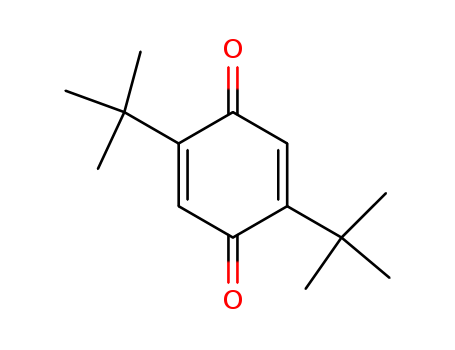
Quality products?make an important contribution to long-term revenue and profitability. Manufacturer supply good quality 2,5-Di-tert-butyl-1,4-benzoquinone 2460-77-7 with stock
1.What is the 2,5-Di-tert-butyl-1,4-benzoquinone ?
Used in Pharmaceutical Industry:
2,5-Di-tert-butyl-1,4-benzoquinone is used as an antibacterial agent for its ability to inhibit bacterial growth. It is particularly valuable in the development of new antibiotics to combat drug-resistant bacteria due to its natural origin and unique chemical structure.
Used in Chemical Research:
DTBBQ serves as a subject of study in chemical research, specifically in understanding the pressure dependence of ion migration rates. This knowledge can be applied to various fields, including material science and the development of new technologies that rely on ion movement.
Used in Marine Biology:
As a compound isolated from marine Streptomyces sp. VITVSK1, 2,5-Di-tert-butyl-1,4-benzoquinone contributes to the study of marine microorganisms and their potential applications in medicine and biotechnology. It can be used to explore the biodiversity of marine ecosystems and the bioactive compounds they produce.
-
-
123-31-9,8027-02-9
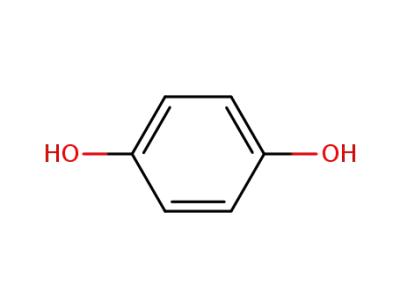
hydroquinone

-
-
75-65-0
tert -butyl alcohol

-
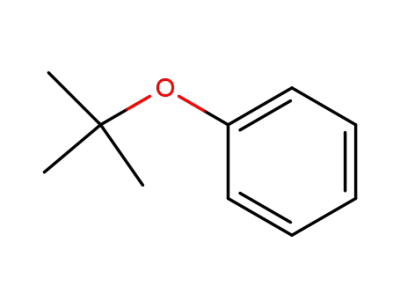
-
6669-13-2
t-butyl phenyl ether
-
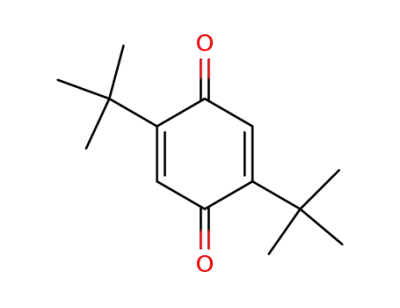
-
2460-77-7
2,5-di-tert-butyl-p-benzoquinone
-
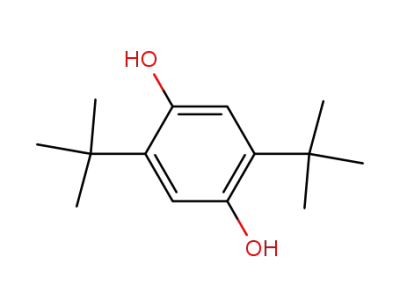
-
88-58-4
2,5-bis(1,1-dimethylethyl)-1,4-benzenediol
-
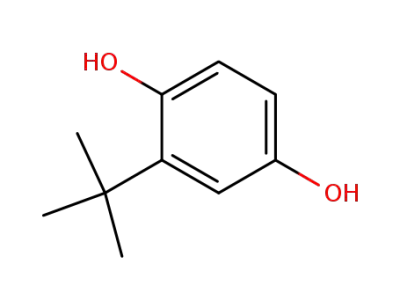
-
1948-33-0
tert-butylhydroquinone
| Conditions | Yield |
|---|---|
|
With
porous pillared-zirconium phosphate functionalized with methyl group;
In
5,5-dimethyl-1,3-cyclohexadiene;
at 150 ℃;
for 4h;
Reagent/catalyst;
Autoclave;
|
48.8%
|
|
With
perfluorosulfonicacid-functionalized carbon nanotubes (PFSA-CNT-0.5);
In
5,5-dimethyl-1,3-cyclohexadiene;
for 4h;
Reagent/catalyst;
Catalytic behavior;
Autoclave;
|
-
-
88-58-4
2,5-bis(1,1-dimethylethyl)-1,4-benzenediol
-
-
2460-77-7
2,5-di-tert-butyl-p-benzoquinone
| Conditions | Yield |
|---|---|
|
With
benzyltrimethylammonium tribromide;
In
water; acetic acid;
for 0.166667h;
Ambient temperature;
|
100%
|
|
With
3-[3,6-dioxo-2-(pyridinium-1-yl)cyclohexa-1,4-dienyl]-2-oxo-2H-chromen-4-olate;
In
methanol; dichloromethane;
at 20 ℃;
for 2.5h;
|
100%
|
|
With
μ-Oxo-I,I'-bis(trifluoroacetato-O)-I,I'-diphenyldiiodine(III);
In
water; acetonitrile;
at 0 ℃;
for 2h;
|
100%
|
|
With
pyridine; 3-carboxypyridinium dichromate;
In
dichloromethane;
for 0.166667h;
Ambient temperature;
|
99%
|
|
With
sodium periodate;
In
dichloromethane;
at 20 ℃;
for 3h;
further solvents;
|
99%
|
|
With
periodate form of Amberlyst A26;
In
chloroform;
at 20 ℃;
for 4h;
|
99%
|
|
With
pyridine; 3-carboxypyridinium dichromate;
In
dichloromethane;
for 0.166667h;
Product distribution;
Ambient temperature;
other ratio of reagents;
|
99%
|
|
With
cerium(IV) ammonium nitrate; silica gel;
In
dichloromethane;
for 0.25h;
|
99%
|
|
With
thiophen-3-yl-λ3-iodanediyl diacetate;
In
methanol;
at 20 ℃;
for 1.16667h;
|
99%
|
|
With
[(4,5-dihydro-4,4-dimethyl-2-phenyloxazole)Ru(CH3CN)4]PF6; dihydrogen peroxide;
In
tetrahydrofuran; water;
at 0 - 20 ℃;
for 0.0833333h;
|
99%
|
|
With
silica gel supported cerium(IV) ammonium nitrate-NaBrO3;
In
dichloromethane; water;
at 40 ℃;
for 2h;
|
99%
|
|
With
cerium(IV); silica gel;
In
dichloromethane;
for 0.0833333h;
Ambient temperature;
|
98%
|
|
With
ammonium cerium(IV) nitrate;
In
solid;
for 2h;
|
98%
|
|
With
dihydrogen peroxide;
Ru(II)(pybox-dh)(pydic);
In
tetrahydrofuran;
at 20 ℃;
for 1.1h;
|
97%
|
|
With
oxygen; cobalt(II)(bis(salicylidene)ethylenediamine);
In
N,N-dimethyl-formamide;
at 45 ℃;
Inert atmosphere;
|
97%
|
|
With
sodium perborate;
In
acetic acid;
at 50 - 60 ℃;
for 4h;
|
96%
|
|
With
sodium hydroxide; sodium bromide; mercury dibromide;
In
dichloromethane; water;
for 0.0833333h;
Ambient temperature;
|
96%
|
|
With
sodium hydroxide; sodium bromide; mercury dibromide;
In
dichloromethane; water;
for 5h;
Product distribution;
oxidation of 1,4-hydroquinones to 1,4-benzoquinones with mercury(II) derivatives;
|
96%
|
|
With
4-phenoxyphenyl telluric anhydride;
In
acetic acid;
at 80 ℃;
for 1h;
|
95%
|
|
With
perchloric acid;
In
perchloric acid;
at 25 ℃;
for 0.5h;
Electrochemical reaction;
|
95%
|
|
With
meso-pentafluoro[26]hexaphyrin(1.1.1.1.1);
In
chloroform-d1;
at 20 ℃;
for 0.166667h;
|
90%
|
|
With
Fe(III)(ethylenediaminetetra-acetate); oxygen;
In
methanol; water;
at 30 ℃;
for 1h;
pH 8,0-8,5;
|
89%
|
|
With
bis-morpholino-tellurium(IV) dichloride;
In
dichloromethane;
for 0.0166667h;
Ambient temperature;
|
83%
|
|
With
manganese(IV) oxide;
In
diethyl ether;
|
82%
|
|
With
diphenyl diselenide; dihydrogen peroxide; tetra(n-butyl)ammonium hydrogensulfate;
In
dichloromethane;
for 3h;
Heating;
|
81%
|
|
With
Selectfluor;
In
acetonitrile;
for 2h;
Ambient temperature;
|
77%
|
|
With
sodium hypochlorite;
tetra(n-butyl)ammonium hydrogensulfate;
In
chloroform;
for 0.0833333h;
Ambient temperature;
|
76%
|
|
With
(P-Py(1+)-n-C6H13)2*Cr2O7(2-);
In
water; benzene;
at 20 ℃;
for 2h;
|
76%
|
|
With
dihydrogen peroxide;
|
|
|
With
nitric acid;
|
|
|
With
iron(III) chloride;
|
|
|
With
potassium bromate;
|
|
|
With
18-crown-6 ether;
In
dimethyl sulfoxide;
|
|
|
With
sodium periodate;
benzyltrimethylammonium chloride;
In
dichloromethane; water;
Ambient temperature;
|
100 % Chromat.
|
|
With
chromium(VI) oxide;
In
acetic acid;
for 1h;
Heating;
|
|
|
With
iron(III) chloride on silica;
In
dichloromethane;
|
99 % Chromat.
|
|
Multi-step reaction
with
2
steps
1: 84 percent / 1,8-diazabicyclo
<5.4.0>
undec-7-ene (DBU) / CH2
Cl2
/ 0.33 h / Ambient temperature
2: 84 percent / trimethylsilyl chlorochromate (3)
/ CH2
Cl2
/ 0.5 h / Ambient temperature
With
dioxochloro(trimethylsiloxy)chromate(VI); 1,8-diazabicyclo[5.4.0]undec-7-ene;
In
dichloromethane;
|
|
|
Multi-step reaction
with
2
steps
1: 83 percent / Triethylamine / CHCl3
2: 99 percent / PCC / CH2
Cl2
/ 2 h / 25 °C / relative reaction rate
With
triethylamine; pyridinium chlorochromate;
In
dichloromethane; chloroform;
|
|
|
Multi-step reaction
with
2
steps
1: 97 percent / acetonitrile
2: 91 percent / PCC / CH2
Cl2
/ 2 h / 25 °C / relative reaction rate
With
pyridinium chlorochromate;
In
dichloromethane; acetonitrile;
|
|
|
Multi-step reaction
with
2
steps
1: 78 percent / hexamethyldisilazane / acetonitrile / 12 h
2: 92 percent / LiClO4
/ acetonitrile / electrolysis on platinum electrode; other solvents; electrochemical oxidation of hydroquinone silyl ethers to quinone
With
lithium perchlorate; 1,1,1,3,3,3-hexamethyl-disilazane;
In
acetonitrile;
|
|
|
Multi-step reaction
with
2
steps
1: 88 percent / Et3
N / CHCl3
/ 25 °C
2: 90 percent / Bu4
NBF4
/ CH2
Cl2
/ electrolysis on platinum electrode
With
tetrabutylammonium tetrafluoroborate; triethylamine;
In
dichloromethane; chloroform;
|
|
|
In
acetone;
|
|
|
With
C14H7IO4(2-)*4HO(1-)*4Al(3+)*3C14H8O4(2-); 3-chloro-benzenecarboperoxoic acid;
In
nitromethane;
at 24 ℃;
for 1h;
Reagent/catalyst;
|
70 %Spectr.
|
2.What is the CAS number for 2,5-Di-tert-butyl-1,4-benzoquinone ?
The CAS number of 2,5-Di-tert-butyl-1,4-benzoquinone is 2460-77-7.
More information of 2,5-Di-tert-butyl-1,4-benzoquinone 2460-77-7 are:
|
CAS?Number |
2460-77-7 |
|
Density |
1.027 g/cm3 |
|
Melting Point |
152-154 °C(lit.) |
|
Boiling Point |
285.405 °C at 760 mmHg |
|
Flash Point |
106.247 °C |
|
Vapor Pressure |
0.00281mmHg at 25°C |
|
Refractive Index |
1.4970 (estimate) |
|
HS CODE |
29146990 |
|
PSA |
34.14000 |
|
LogP |
3.08320 |
3.What are another words for 2,5-Di-tert-butyl-1,4-benzoquinone ?
Synonyms?for?2,5-Di-tert-butyl-1,4-benzoquinone 2460-77-7:NSC 43579;2,5-Di-tert-butylbenzoquinone;NSC7489;p-Benzoquinone,2,5-di-tert-butyl- (6CI,7CI,8CI);2,5-Di-tert-butyl-2,5-cyclohexadiene-1,4-dione;2,5-Di-tert-butyl-p-benzoquinone;
4.What is the molecular formula of 2,5-Di-tert-butyl-1,4-benzoquinone?
The chemical formula of ?2,5-Di-tert-butyl-1,4-benzoquinone is?C14H20O2 which containing 14 Carbon atoms,20 Hydrogen atoms and 2 Oxygen atoms,and the molecular weight of??2,5-Di-tert-butyl-1,4-benzoquinone?is 220.312.
5.What is 2,5-Di-tert-butyl-1,4-benzoquinone (2460-77-7) used for?
2,5-Di-tert-butyl-1,4-benzoquinone (DTBBQ) is a 2,5-disubstituted quinone that has been identified as an antibacterial compound. It is derived from marine Streptomyces sp. VITVSK1 and has been studied for its pressure dependence on the intramolecular and intermolecular migration rates of Na+ and K+ using a high-pressure EPR technique. DTBBQ is characterized by its yellow to golden crystalline powder appearance.
InChI:InChI=1/C14H20O2/c1-13(2,3)9-7-12(16)10(8-11(9)15)14(4,5)6/h7-8H,1-6H3
Relevant articles related to 2,5-Di-tert-butyl-1,4-benzoquinone:
|
Article |
Source |
|
A rapid and efficient synthesis of quinone derivatives: Ru(II)-or Ir(I)-catalyzed hydrogen peroxide oxidation of phenols and methoxyarenes |
Iwasa, Seiji,Fakhruddin, Ahmad,Widagdo, Herman Setyo,Nishiyama, Hisao , p. 517 - 520 (2005) |
|
Oxidation of hydroquinones with meso-hexakispentafluorophenyl [26]hexaphyrin(1.1.1.1.1.1) |
Maeda, Chihiro,Shinokubo, Hiroshi,Osuka, Atsuhiro , p. 200 - 202 (2006) |
6.Buy 2,5-Di-tert-butyl-1,4-benzoquinone with the best price .
Anhui Hefei Aiersen Chemicals Co,.Ltd is a quality supplier of 2,5-Di-tert-butyl-1,4-benzoquinone. Our main goal is customer satisfaction. Contact us to negotiate the best price for your business on 2,5-Di-tert-butyl-1,4-benzoquinone 2460-77-7.
Related Products
-
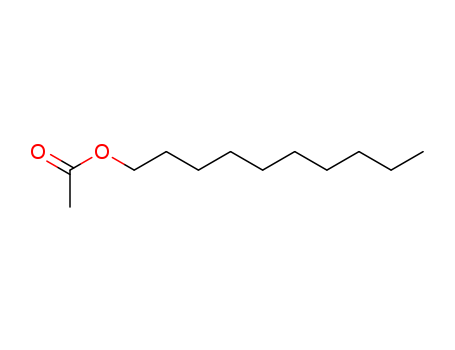 N-DECYL ACETATE
CAS:112-17-4
-
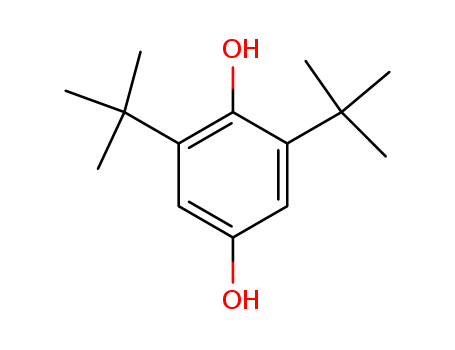 2,6-di-tert-butylhydroquinone
CAS:2444-28-2
-
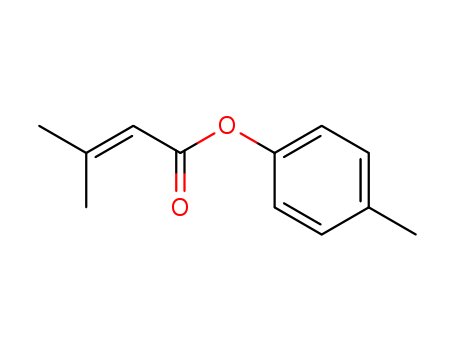 p-tolyl 3-methylcrotonate
CAS:24700-20-7